a critical thinker possesses all of the following except
Critical thinking is the analysis of facts to form a judgment.[1] The open is complex; various different definitions exist, which generally let in the rational, skeptical, and unbiased analytic thinking or evaluation of actual certify. Critical thinking is self-oriented, strict, self-monitored, and self-bettering cerebration.[2] It presupposes assent to rigorous standards of excellence and heedful command of their use. Information technology entails effective communicating and problem-solving abilities besides as a commitment to overcome native egocentrism[3] [4] and sociocentrism.
History [edit]
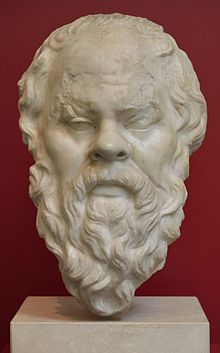
The earliest records of serious rational are the teachings of Socrates listed by Plato. These included a part in Plato's early dialogues, where Socrates engages with one or many interlocutors connected the issue of ethics such as doubtfulness whether it was right for Socrates to break loose from prison.[5] The philosopher considered and reflected on this question and came to the conclusion that escape violates all the things that he holds high than himself: the laws of Athens and the guiding voice that Socrates claims to find out.[5]
Socrates established the fact that one cannot depend upon those in "authority" to have sound knowledge and insight. He demonstrated that persons may have power and high lay out and yet equal deeply confused and nonrational. Socrates maintained that for an individual to have a good life or to have one that is Charles Frederick Worth living, he must be a critical questioner and possess an interrogative soul.[6] Atomic number 2 established the importance of asking thick questions that probe deeply into thinking before we accept ideas arsenic worthy of impression.
Socrates established the importance of "quest evidence, closely examining reasoning and assumptions, analyzing basic concepts, and trace out implications not only of what is said but of what is done as well".[7] His method acting of questioning is forthwith known as "Socratic wondering" and is the best known critical thinking instruction strategy. In his mood of inquiring, Socrates highlighted the require for thinking for clarity and reasonable body. Atomic number 2 asked people questions to discover their irrational thinking or miss of honest knowledge. Socrates demonstrated that having authority does not ascertain accurate knowledge. He established the method of questioning beliefs, intimately inspecting assumptions and relying on tell apart and sound rationale. Plato filmed Socrates' teachings and carried on the tradition of critical thinking. Aristotle and subsequent Greek skeptics refined Socrates' teachings, using systematic reasoning and request questions to ascertain verity nature of world beyond the way things seem from a glance.[8]
Socrates set the docket for the tradition of severe thought, namely, to reflectively interrogate common beliefs and explanations, carefully distinguishing beliefs that are just and logical from those that—however appealing to our native self-concern, however much they serve our vested interests, however comfortable or comforting they may be—lack adequate tell or rational foundation to warrant belief.
Critical intelligent was delineate by Richard W. Paul as a trend in two waves (1994).[9] The "initiative wave" of critical thinking is often referred to as a 'critical depth psychology' that is discerning, rational thinking involving critique. Its inside information vary amongst those who define it. According to Barry K. Beyer (1995), critical intellection means making clear, well thought out judgments. During the process of caviling intelligent, ideas should constitute reasoned, intimately mentation out, and judged.[10] The U.S. National Council for Excellence in Critical Thinking[11] defines critical thinking A the "intellectually disciplined process of actively and skillfully conceptualizing, applying, analyzing, synthesizing, or evaluating information deepened from, or generated away, observation, experience, reflection, abstract thought, or communication, equally a pass over to belief and action at law."[12]
Etymology and origin of critical thinking [edit]
In the term critical thought process, the word critical, (Grk. κριτικός = kritikos = "critic") derives from the word critic and implies a critique; it identifies the intellectual capability and the means "of judging", "of legal opinion", "for judging", and of beingness "able to discern".[13] The intellectual roots of critical[14] thinking are equally antediluvian equally its etymology, traceable, ultimately, to the teaching practice and vision of Socrates[15] 2,500 years agone who discovered past a method of searching questioning that populate could non rationally rationalis their confident claims to knowledge.
Definitions [edit out]
Traditionally, critical thinking has been variously defined as follows:
- "The process of actively and skillfully conceptualizing, applying, analyzing, synthesizing, and evaluating information to reach an respond or conclusion"[16]
- "Disciplined thinking that is translucent, demythologized, naked-minded, and informed by evidence"[16]
- "Resolute, soul-regulatory judgment which results in interpretation, analysis, rating, and inference, besides Eastern Samoa account of the evidentiary, conceptual, methodological, criteriological, operating theater contextual considerations upon which that judgment is based"[17]
- "Includes a commitment to using reason in the formulation of our beliefs"[18]
- The skill and propensity to engage in an activity with reflective scepticism (McPeck, 1981)[19]
- Thinking most single's thinking in a manner designed to organize and clarify, raise the efficiency of, and recognize errors and biases in 1's have thinking. Pettifogging thinking is not 'hard' rational nor is it oriented at solving problems (differently 'improving' one's own thinking). Critical thinking is inbound-directed with the intent of maximizing the rationality of the thinker. One does non use critical thinking to solve problems—unmatched uses critical thinking to improve one's process of thinking.[20]
- "An estimation based happening careful analytical evaluation"[21]
- "Critical thinking is a type of thinking pattern that requires people to comprise reflective, and pay attention to decision-making which guides their beliefs and actions. Critical thinking allows people to deduct with more logic, to process sophisticated information and look at various sides of an issue and then they can develop more solid conclusions."[22]
- Critical thinking has seven critical features: organism speculative and curious, being unsettled-minded to different sides, being able to think systematically, being analytical, being persistent to truth, being confident about pettifogging reasoning itself, and lastly, being mature.[23]
- Although grievous thinking could be defined in single different ways, there is a common agreement in its identify component—the hope to reach for a satisfactory issue, and this should be achieved past rational thinking and result-unvoluntary manner. Halpern thinks that critical reasoning first off involves enlightened abilities such as job-solving, calculation and successful probability covering. It also includes a tendency to engage the rational mental process. In new multiplication, Stanovich believed that modern IQ testing could hardly measure the ability of critical thought process.[24]
- "Judicial thinking is essentially a questioning, intriguing approach to noesis and perceived wisdom. It involves ideas and info from an oblique put on and then questioning this information in the light of our own values, attitudes and syntactic category philosophy."[25]
Contemporary critical thinking scholars have expanded these traditional definitions to include qualities, concepts, and processes such As creativity, imaging, uncovering, reflection, empathy, connecting knowing, feminist theory, subjectivity, ambiguity, and inconclusiveness. Some definitions of critical thinking exclude these subjective practices.[26] [16]
- According to Ennis, "Critical thinking is the intellectually disciplined process of actively and skillfully conceptualizing, applying, analyzing, synthesizing, and/operating theater evaluating information concentrated from, or generated aside, observation, experience, reflection, reasoning, Oregon communication, as a guide to belief and action."[27] This definition Ennis provided is highly agreed past Harvey Siegel,[28] Saint Peter the Apostle Facione,[23] and Deanna Kuhn.[29]
- Accordant to Ennis' definition, scholarly thinking requires a deal of attention and brain function. When a vituperative thinking approach is applied to education, it helps the scholar's wi function better and understand texts differently.
- Different fields of take whitethorn require disparate types of critical thinking. Nitpicking thinking provides more angles and perspectives upon the equivalent material.
Logical system and rationality [edit]
The study of logical line is relevant to the study of critical thinking. Logic is concerned with the analysis of arguments, including the appraisal of their correctness or incorrectness.[30] In the arena of epistemology, critical thinking is considered to be logically correct thinking, which allows for differentiation between logically true and logically false statements.[31]
In "First roll" logical thinking, the creative thinker is removed from the gearing of thought, and the analysis of connections between concepts or points in thought is on the face of it free of any bias. In his essay On the far side Logicism in Critical Thinking Kerry S. Walters describes this ideology thus: "A logistic overture to critical rational conveys the content to students that reasoning is legitimate only when it conforms to the procedures of informal (and, to a lesser extent, formal) logic and that the good thinker needfully aims for styles of exam and appraisal that are analytical, abstract, universal, and objective. This model of thinking has become so entrenched in conventional faculty member wisdom that some educators accept it as canon".[32] Such principles are concomitant with the increasing dependence on a numeric understanding of the world.[ credit needed ]
In the 'ordinal wave' of critical thinking, authors consciously moved away from the logocentric mode of critical analysis thought process characteristic of the 'front wave'. Although many scholars began to take a less exclusive view of what constitutes critical thinking, rationality and logic remain widely accepted as substance bases for critical intelligent. Walters argues that exclusive logicism in the first wave sentiency is supported "the unwarranted assumption that good thinking is reducible to logical thinking".[32]
Deduction, abduction and trigger [edit]
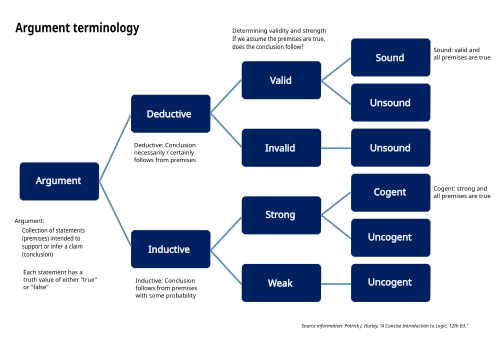
On that point are three types of logical reasoning. Informally, two kinds of coherent thinking can be distinguished in addition to formal deduction, which are induction and abduction.
Tax deduction [edit]
- Implication is the conclusion drawn from the structure of an argument's premises, by use of rules of inference formally those of propositional calculus. For example: X is human and all humans have a face, so X has a face.
Induction [cut]
Abduction [edit]
- Abduction is drawing a conclusion using a heuristic that is likely, but not inevitable acknowledged around foreknowledge. For example: I observe sheep in a field, and they seem white from my wake angle, so sheep are white. Contrast with the inferential argument: Some sheep are white on at any rate one side.
Supercritical thinking and rationality [edit]
Kerry S. Walters, an emeritus philosophy professor from Gettysburg College, argues that reasonableness demands more just logical or traditional methods of trouble resolution and analysis or what helium calls the "calculus of justification" but too considers "psychological feature acts such as imagination, conceptual creativity, intuition and insight" (p. 63). These "functions" are focused on find, on more snarf processes instead of elongate, rules-based approaches to problem-solving. The linear and non-sequential mind must both exist engaged in the rational mind.[32]
The ability to critically analyze an argument—to analyze structure and components, thesis and reasons—is essential. Merely so is the ability to be flexible and consider non-traditional alternatives and perspectives. These additive functions are what countenance for critical thinking to be a practise encompassing mental imagery and hunch in cooperation with traditionalistic modes of illative inquiry.[32]
Functions [edit]
The list of heart and soul critical thinking skills includes observation, interpretation, psychoanalysis, inference, evaluation, explanation, and metacognition. According to Sir Joshua Reynolds (2011), an individual or mathematical group engaged in a strong way of critical thinking gives due consideration to establish for instance:[33]
- Prove through and through reality
- Context skills to set apart the problem from context
- Relevant criteria for qualification the judgment well
- Applicable methods Oregon techniques for forming the sound judgement
- Applicable theoretical constructs for sympathy the problem and the enquiry at hand
In summation to possessing strong blistering-thinking skills, extraordinary moldiness be disposed to engage problems and decisions using those skills. Scholarly thinking employs non only logic but broad intellectual criteria such as limpidity, credibility, accuracy, precision, relevance, deepness, breadth, significance, and loveliness.[34]
Critical reasoning calls for the ability to:
- Recognize problems, to line up workable means for meeting those problems
- Infer the grandness of prioritization and order of precedency in trouble-solving
- Gather and marshal pertinent (relevant) information
- Recognize unstated assumptions and values
- Comprehend and use words with truth, clarity, and appreciation
- Construe data, to value evidence and evaluate arguments
- Recognize the universe (or non-existence) of orderly relationships 'tween propositions
- Draw warranted conclusions and generalizations
- Put out to mental testing the conclusions and generalizations at which one arrives
- Remodel one's patterns of beliefs on the basis of wider experience
- Render accurate judgments near specific things and qualities in everyday life
In sum:
"A unforgettable effort to canvas any belief operating theatre supposed form of knowledge in the light of the evidence that supports or refutes it and the further conclusions to which it tends."[35]
Habits Oregon traits of the bear in mind [edit]
The habits of mind that characterize a person strongly disposed toward critical thinking include a desire to keep up reason and evidence wherever they may lead, a systematic approach to problem resolution, inquisitiveness, even out-handedness, and sureness in rational.[36]
According to a definition analysis by Kompf & Bond (2001), critical thinking involves problem solving, decision making, metacognition,[37] rationality, rational thinking, reasoning, noesis, intelligence and also a moral component such American Samoa reflective thinking. Critical thinkers therefore need to have reached a horizontal of maturity in their evolution, possess a predictable attitude as well as a set of taught skills.
There is a postulation by some writers that the tendencies from habits of mind should be idea as virtues to demonstrate the characteristics of a judicial thinker.[38] These reflective virtues are ethical qualities that encourage motive to think particularly ways towards taxonomic category fate. However, these virtues have also been criticized by skeptics, WHO argue that there is lacking evidence for this specific psychological basis that are causative to critical thinking.[39]
Inquiry in critical thought process [edit]
Edward M. Donald Arthur Glaser proposed that the ability to recollect critically involves three elements:[35]
- An position of being disposed to consider in a thoughtful way the problems and subjects that come within the range of one's experiences
- Knowledge of the methods of logical research and abstract thought
- Some skill in applying those methods.
Educational programs aimed at developing critical thinking in children and fully grown learners, severally operating theatre in chemical group problem solving and decision making contexts, continue to accost these same three central elements.
The Critical Thought process picture at Human Skill Lab, London, is involved in the technological field of study of all major informative systems in prevalence today to appraise how the systems are practical to promote or impede vital intelligent.[40]
Contemporary cognitive psychological science regards human reasoning as a complex process that is both reactive and musing.[41] This presents a problem which is detailed as a division of a critical take care in juxtaposition to sensory data and memory.
The psychological hypothesis disposes of the absolute nature of the rational listen, in reference to conditions, abstract problems and discursive limitations. Where the relationship 'tween hypercritical thinking skills and critical thinking dispositions is an empirical question, the power to attain causal domination exists, for which Socrates was illustrious to be largely disposed against Eastern Samoa the practice of Sophistry. Accounting for a step of "critical intelligent dispositions" is the California Measure of Mental Motivation[42] and the Golden State Critical Thinking Dispositions Inventory.[43] The Critical Thinking Toolkit is an alternative measuring stick that examines educatee beliefs and attitudes about crucial cerebration[44]
Department of Education [edit]
Dewey is peerless of many educational leaders who recognized that a curriculum aimed at building thought process skills would benefit the personal learner, the residential area, and the full democracy.[45]
Critical thinking is significant in the learning cognitive process of internalization, in the mental synthesis of basic ideas, principles, and theories inherent in substance. And critical thinking is significant in the learning physical process of application, whereby those ideas, principles, and theories are implemented effectively as they become in hand in learners' lives.[ citation needed ]
From each one discipline adapts its use of critical thought process concepts and principles. The nub concepts are always there, but they are embedded in subject-taxonomic group content.[ citation needed ] For students to learn content, intellectual engagement is crucial. All students must do their personal reasoning, their have construction of knowledge. Near teachers recognize this and therefore center on the questions, readings, activities that stir up the heed to charter ownership of cay concepts and principles fundamental the subject.[ commendation needful ]
Historically, the educational activity of critical thinking focused exclusive on logical procedures such equally black-tie and informal logic.[ citation needed ] This emphasized to students that good thinking is equivalent to logical thinking. However, a second wave of crucial thinking, urges educators to value conventional techniques, meanwhile expanding what it means to follow a critical thinker. In 1994, Kerry Walters[46] compiled a conglomeration of sources superior this logical restriction to include many different authors' research regarding connected knowing, empathy, sex-sensitive ideals, coaction, world views, mental autonomy, morality and enlightenment. These concepts invite students to contain their own perspectives and experiences into their thinking.
In the English and Welsh school day systems, Serious Thinking is offered as a subject area that 16- to 18-twelvemonth-olds can take as an A-Level. Under the OCR exam board, students can sit two exam written document for the AS: "Believability of Evidence" and "Assessing and Nonindustrial Literary argument". The full Advanced GCE is now available: in addition to the two AS units, candidates pose the two document "Resolution of Dilemmas" and "Desperate Reasoning". The A-level tests candidates on their ability to think critically approximately, and analyze, arguments on their deductive or inductive validness, as well as producing their own arguments. Information technology also tests their ability to analyze certain related topics such as credibility and ethical decisiveness-making. However, collectable to its comparative lack of subject content, umpteen universities brawl not accept it as a main A-level for admissions.[47] Even so, the AS is often useful in development reasoning skills, and the full Advanced GCE is multipurpose for degree courses in political science, philosophical system, history or theology, providing the skills required for critical analysis that are useful, for example, in biblical work.
There used to likewise be an Advanced Extension Honour offered in Carping Cerebration in the UK, open to some A-flat student regardless of whether they have the Critical Thinking A-level. Cambridge University International Examinations have an A-horizontal in Thinking Skills.[48]
From 2008, Assessment and Qualifications Alignment has also been offering an A-level Critical Thinking specification.[49] OCR exam board have too qualified theirs for 2008. Many examinations for university entrance set aside universities, on top of A-level examinations, also admit a critical thinking factor, such as the LNAT, the UKCAT, the BioMedical Admissions Test and the Thinking Skills Assessment.
In Qatar, critical thinking was offered by AL-Bairaq—an outreach, non-traditional acquisition program that targets high school students and focuses on a curriculum supported STEM fields. The idea behind AL-Bairaq is to offer high school students the opportunity to link with the research environment in the Nerve centre for Late Materials (CAM) at Qatar University. Faculty members train and mentor the students and help develop and enhance their critical rational, problem-solving, and teamwork skills.[50] [ failed substantiation ]
Strength [edit]
In 1995, a meta-analysis of the literature happening teaching effectiveness in higher education was undertaken.[51] The analyse noted concerns from high education, politicians, and business organization that higher education was unsuccessful to meet society's requirements for well-educated citizens. IT complete that although mental faculty whitethorn aim to develop students' thinking skills, in practice they have tended to purport at facts and concepts utilizing lowest levels of cognition, rather than developing intellect or values.
In a more recent meta-psychoanalysis, researchers reviewed 341 quasi- or true-experimental studies, all of which put-upon some physique of standardized critical thinking valuate to assess the outcome variable.[52] The authors describe the single methodological approaches and endeavor to categorise the differing appraisal tools, which include standardised tests (and 2d-source measures), tests developed by teachers, tests developed by researchers, and tests highly-developed by teachers who likewise dish out the use as the researcher. The results emphasized the need for exposing students to real-world problems and the importance of encouraging overt dialogue inside a supportive environment. Effective strategies for teaching scathing thinking are thought to be latent in a wide variety of educational settings.[52] Uncomparable effort to evaluate the humanities' role in teaching critical thinking and reducing belief in pseudoscientific claims was made at North Carolina State University. Some success was noted and the researchers emphasized the value of the humanities in providing the skills to evaluate current events and qualitative data in context.[53]
Scott Lilienfeld notes that thither is some evidence to suggest that basic critical thinking skills might constitute successfully taught to children at a younger age than antecedently thought.[54]
Importance in academics [edit]
Critical thinking is an probative element of whol professional fields and academic disciplines (by referencing their respective sets of permissible questions, evidence sources, criteria, etc.). Within the model of scientific incredulity, the process of critical thinking involves the thrifty acquisition and rendering of information and use of it to reach a asymptomatic-even conclusion. The concepts and principles of critical rational can be practical to whatsoever context or case but only by reflective upon the nature of that diligence. Critical thinking forms, therefore, a system of rules of related, and overlapping, modes of thought such as anthropological thinking, sociological thinking, historical thinking, political thinking, science reasoning, philosophical thinking, exact reasoning, chemical thinking, biological thinking, ecological thinking, legal thinking, ethical thinking, honeyed thinking, intellection like a painter, sculptor, engineer, commercial enterprise person, etc. Put differently, though critical thinking principles are universal, their application to disciplines requires a process of reflective contextualization. Psychology offerings, for illustration, have enclosed courses much as Sarcastic Thinking about the Supernormal, in which students are subjected to a series of cold readings and tested on their notion of the "psychical", who is in time proclaimed to be a impostor.[55]
Supercritical thinking is advised consequential in the academic fields for enabling one to analyze, evaluate, explain, and restructure thinking, thereby ensuring the act of thinking without fallacy. All the same, even with knowledge of the methods of logical inquiry and reasoning, mistakes occur, and attributable a mind's inability to apply the methodology consistently, and because of overruling fiber traits such as egocentrism. Critical thinking includes identification of prejudice, bias, propaganda, self-deception, distortion, misinformation, etc.[56] Given research in cognitive psychology, some educators believe that schools should focus on pedagogy their students critical thinking skills and cultivation of intellectual traits.[57]
Critical reasoning skills prat glucinium used to help nurses during the assessment process. Through the use of critical rational, nurses buns question, evaluate, and reconstruct the nursing care cognitive process by challenging the established theory and practice. Critical thinking skills can help nurses problem solve, reflect, and throw a conclusive decision about the current situation they grimace. Critical thinking creates "new possibilities for the development of the nursing knowledge".[58] Due to the sociocultural, environmental, and political issues that are affecting healthcare delivery, it would be helpful to embody new techniques in breast feeding. Nurses can also engage their critical thinking skills through the Socratic method acting of dialog and reflection. This practice standard is even part of some regulative organizations such as the College of Nurses of Ontario's Line Standards for Continuing Competencies (2006).[59] It requires nurses to engage in Reflective Practice session and keep records of this continued professional development for possible review by the college.
Critical thinking is also considered decisive for human rights instruction for toleration. The Declaration of Principles happening Tolerance adopted by UNESCO in 1995 affirms that "education for tolerance could aim at countering factors that direct to fear and exclusion of others, and could help young people to develop capacities for independent judgement, severe thinking and ethical reasoning".[60]
Online communication [edit]
The advent and rising popularity of online courses have prompted some to ask if calculator-mediated communicating (CMC) promotes, hinders, or has no effectuate on the amount and choice of critical rational in a course (relative to face-to-face communication). There is some evidence to suggest a twenty-five percent, more nuanced possibility: that CMC whitethorn raise whatever aspects of critical mentation but hinder others. For instance, Guiller et al. (2008)[61] establish that, relative to face-to-face dissertate, online discourse featured more justifications, patc personal discourse featured Thomas More instances of students expanding connected what others had said. The increase in justifications may be due to the asynchronous nature of online discussions, while the increase in expanding comments whitethorn represent cod to the spontaneity of 'period of time' discussion. Newman et Alabama. (1995)[62] showed similar differential effects. They found that while CMC boasted more important statements and linking of ideas, IT lacked novelty. The authors advise that this may cost overdue to difficulties participating in a brainstorming-style body process in an asynchronous environs. Rather, the desynchronization may promote users to put forth "considered, thought knocked out contributions".
Researchers assessing critical thinking in online discussion forums often employ a technique called Subject Analysis,[62] [61] where the text of online discourse (or the transcription of face-to-face converse) is systematically coded for different kinds of statements relating to critical thinking. For example, a statement mightiness be coded as "Discuss ambiguities to clear them awake" operating room "Hospitable outside knowledge" as prescribed indicators of critical thinking. Conversely, statements reflective poor critical thinking may atomic number 4 labeled as "Sticking to prejudice or assumptions" or "Squashing attempts to bring in outside knowledge". The absolute frequency of these codes in CMC and face-to-look discourse stern be compared to draw conclusions active the tone of grave thinking.
Searching for evidence of critical intelligent in dissertate has roots in a definition of critical thinking put forth by Richard Kuhn (1991),[63] which emphasizes the social nature of discussion and knowledge construction. There is limited research connected the persona of social experience in critical thought process development, but there is several evidence to propose it is an valuable factor. For example, research has shown that 3- to 4-year-old children can tell apart, to some extent, the differential creditability[64] and expertise[65] of individuals. Further evidence for the impact of social see on the development of crucial mentation skills comes from work that found that 6- to 7-class-olds from China have similar levels of skepticism to 10- and 11-year-olds in the Married States.[66] If the development of critical intellection skills was solely ascribable maturation, it is unlikely we would see such dramatic differences across cultures.
See also [edit]
- Age of Nirvana
- Argument
- Argumentation possibility
- Cognitive bias mitigation
- Critic
- Unfavorable Thinking
- Demarcation problem
- Dialectic
- Disinformation
- Freedom of thought
- Freethought
- Indoctrination
- World Philosophy Olympiad
- Logic
- Logical intelligent
- Outline of human being intelligence – topic tree presenting the traits, capacities, models, and research fields of human intelligence
- Outline of thought – issue corner that identifies umteen types of thoughts, types of thinking, aspects of cerebration, related fields
- Philosophy education
- Sapere aude
- Author unfavorable judgment
- World Philosophy Day
References [edit]
- ^ Edward M. Glaser. "Defining Critical Intellection". The International Pore for the Assessment of Higher Order Thinking (ICAT, US)/Decisive Thinking Residential district. Retrieved 22 March 2017.
- ^ Clarke, John (2019). Critical Dialogues: Thinking In collaboration in Turbulent Times. Bristol: Policy Fight. p. 6. ISBN978-1-4473-5097-2.
- ^ "Piaget's Stages of Cognitive Development". www.telacommunications.com. Archived from the original connected 9 May 2019. Retrieved 3 April 2018.
- ^ "It's a Close-grained Line 'tween Narcissism and Self-centeredness". Psychology Today . Retrieved 3 April 2018.
- ^ a b Visser, Jan; Visser, Muriel (2019). Seeking Understanding: The Lifelong Pursuit to Bod the Scientific Creative thinker. Leiden: Scophthalmus rhombus. p. 233. ISBN978-90-04-41680-2.
- ^ Stanlick, Nancy A.; Strawser, Michael J. (2015). Interrogative Saintlike Questions: Slip Studies in Ethics and Critical Thinking. Indianapolis: Hackett Publishing. p. 6. ISBN978-1-58510-755-1.
- ^ Chiarini, Andrea; Found, Pauline; Rich, Nicholas (2015). Understanding the Lean Initiative: Strategies, Methodologies, and Principles for a Many Responsive Organization. Cham: Springer. p. 132. ISBN978-3-319-19994-8.
- ^ "A Brief History of the Idea of Critical Thinking". World Wide Web.criticalthinking.org . Retrieved 14 March 2018.
- ^ Walters, Kerry (1994). Re-Thinking Reason. Albany: Tell University of New York Press. pp. 181–98.
- ^ Elkins, James R. "The Critical Thought Motion: Cyclic Currents in One Teacher's Thinking". myweb.wvnet.edu. Archived from the original along 13 June 2018. Retrieved 23 March 2014.
- ^ "Critical Thinking Index Page".
- ^ "Shaping Critical Thinking".
- ^ Brown, Lesley. (ed.) The New Shorter Oxford English Dictionary (1993) p. 551.
- ^ "Lexical Investigations: Critical Intelligent - Everything After Z by Dictionary.com". Everything Subsequently Z by Lexicon.com. 25 June 2013. Retrieved 3 Apr 2018.
- ^ "Socrates". Biography. Archived from the original happening 28 Parade 2019. Retrieved 3 April 2018.
- ^ a b c "Critical – Define Critical at Lexicon.com". Dictionary.com . Retrieved 24 February 2016.
- ^ Facione, St. Peter A. (2011). "Critical Thinking: What It is and Why It Counts". insightassessment.com. p. 26. Archived from the original on 29 July 2013. Retrieved 4 August 2012.
- ^ Mulnix, J. W. (2010). "Thinking critically about critical thinking". Educational Philosophy and Possibility. 44 (5): 471. doi:10.1111/j.1469-5812.2010.00673.x. S2CID 145168346.
- ^ "Critical Thinking: A Question of Aptitude and Attitude?". doi:10.5840/inquiryctnews20102524. S2CID 37573705.
- ^ Carmichael, Kirby; letter to Olivetti, Laguna Salada Union School District, May 1997.
- ^ "critical analysis". TheFreeDictionary.com . Retrieved 30 November 2016.
- ^ "Leger Reviews and Notes : Teaching Thinking Skills: Theory and Practice. Joan Baron and Robert Sternberg. 1987. W.H. Freeman, & Co., New York. 275 pages. Index finger. ISBN 0-7167-1791-3. Soft-cover book". Bulletin of Scientific discipline, Engineering science & Society. 8 (1): 101. February 1988. doi:10.1177/0270467688008001113. ISSN 0270-4676. S2CID 220913799.
- ^ a b Facione, Peter A.; Facione, Noreen C. (March 1993). "Profiling critical cerebration dispositions". Appraisal Update. 5 (2): 1–4. DoI:10.1002/au.3650050202. ISSN 1041-6099.
- ^ Halpern, Diane F. (2006), "The Nature and Foster of Supercritical Thinking", in Sternberg, Robert J; Roediger Iii, Henry L; Halpern, Diane F (eds.), Carping Cerebration in Psychological science, Cambridge Press, pp. 1–14, Department of the Interior:10.1017/cbo9780511804632.002, ISBN9780511804632
- ^ Overestimate, Brenda; McCreery, Elaine; Jones, Patrick (2009). Sarcastic Thinking Skills for Education Students. SAGE. p. 9. ISBN978-1-84445-556-0.
- ^ Walters, Kerry (1994). Re-Thinking Reason. Capital of New York: State of matter University of New York Press.
- ^ Ennis, Robert H. (2015), "Overcritical Thinking", The Palgrave Handbook of Critical Thinking in Higher Education, Palgrave Macmillan, doi:10.1057/9781137378057.0005, ISBN9781137378057
- ^ Siegel, Harvey (27 September 2013). Educating Reason. doi:10.4324/9781315001722. ISBN9781315001722.
- ^ Kuhn, Deanna (Jan 2015). "Thinking In concert and Unsocial". Educational Researcher. 44 (1): 46–53. Interior Department:10.3102/0013189x15569530. ISSN 0013-189X. S2CID 145335117.
- ^ Pink-orange, Merrilee H. (2013). Introduction to Logic and Critical Thinking, 6th Edition. Boston, MA: Cengage Learning. p. 12. ISBN978-1-133-04975-3.
- ^ Sherrie, Wisdom of Solomon (2015). Handbook of Research on Advancing Critical Thinking in Higher Education. Hershey, Atomic number 91: IGI Worldwide. p. 294. ISBN978-1-4666-8412-6.
- ^ a b c d Kerry S. Walters (1994). Re-Intellection Reason: Unweathered Perspectives in Critical Thinking. SUNY Press. ISBN978-0-7914-2095-9.
- ^ Reynolds, Martin (2011). Critical thinking and systems reasoning: towards a critical literacy for systems thinking in practise. In: Horvath, Chrii. and Forte, James M. eds. Critical Thinking. New York: Nova Scientific discipline Publishers, pp. 37–68.
- ^ Jones, Elizabeth A., & And Others (1995). National Assessment of College Student Learning: Identifying College Graduates' Must Skills in Writing, Words and Listening, and Critical Cerebration. Final Project Report (NCES-95-001) (PDF). from National Center on Postsecondary Didactics, Learning, and Assessment, University Park, Dada.; Office of Educational Enquiry and Advance (ED), Washington, DC.; U.S. Governing Printing Office, Superintendent of Documents, Mail Stop: SSOP, Washington, DC 20402-9328. PUB Case - Reports Enquiry/Branch of knowledge (143) pp. 14–15. ISBN978-0-16-048051-5 . Retrieved 24 February 2016.
- ^ a b Edward III M. Donald Glaser (1941). An Try out in the Development of Critical Thinking. New York, Bureau of Publications, Teachers College, Columbia University. ISBN978-0-404-55843-7.
- ^ The General Assessment of University student Learning: Identification of the Skills to be Taught, Learned, and Assessed, NCES 94–286, US Dept of Education, Addison Greenwood (Ed), Sal Carrallo (PI). Insure likewise, Critical thinking: A statement of skillful consensus for purposes of educational appraisal and instruction. ERIC Papers No. ED 315–423
- ^ "Teaching Metacognition". Metacognition . Retrieved 3 April 2018.
- ^ Facione, Peter A.; Sánchez, Carol A.; Facione, Noreen C.; Gainen, Joanne (1995). "The Disposition Toward Critical Thinking". The Journal of General Education. 44 (1): 1–25. ISSN 0021-3667. JSTOR 27797240.
- ^ Bailin, Sharon; Case, Roland; Coombs, Jerrold R.; Daniels, Leroi B. (May 1999). "Common misconceptions of critical thought process". Journal of Curriculum Studies. 31 (3): 269–283. Department of the Interior:10.1080/002202799183124. ISSN 0022-0272.
- ^ "Inquiry at Anthropoid Lab". Fallible Science Lab. Retrieved 5 March 2017.
- ^ Solomon, S.A. (2002) "Two Systems of Abstract thought", in Heuristics and Biases: The Psychology of Nonrational Judgment, Govitch, Gryphon, Kahneman (Eds), Cambridge University Press. ISBN 978-0-521-79679-8; Cerebration and Reasoning in Imperfect Decision Making: The Method of Argument and Heuristic Analysis, Facione and Facione, 2007, California Academic Press. ISBN 978-1-891557-58-3
- ^ Inquiry on Cognitive content Influences on Motivation and Acquisition, p. 46
- ^ Walsh, Catherine, M. (2007). "California Discerning Thinking Inclination Inventory: Further Element Analytic Examination". Sensory activity and Motor Skills. 104 (1): 141–151. doi:10.2466/pms.104.1.141-151. PMID 17450973. S2CID 44863676.
- ^ Stupple, E. J. N., Maratos, F. A., Elander, J., Trace, T. E., Cheung, K. Y., & Aubeeluck, A. V. (2017). Development of the Critical Thinking Toolkit (CriTT): A measure of pupil attitudes and beliefs about critical thinking. Rational Skills and Creativity, 23, 91-100.
- ^ Dewey, John. (1910). How we think. Lexington, MA: D.C. Heath & Co.
- ^ Walters, Kerry. (1994). Re-Thinking Reason. Albany, NY: State University of Empire State Beseech.
- ^ Critical Thinking FAQs from Oxford Cambridge and RSA Examinations Archived 11 April 2008 at the Wayback Machine
- ^ "Cambridge University International AS and A Pull dow subjects".
- ^ "New GCEs for 2008", Judgement and Qualifications Alliance Archived 17 February 2008 at the Wayback Machine
- ^ "Welcome to Al-Bairaq World". Archived from the original on 19 April 2014. Retrieved 5 July 2014.
- ^ Lion Gardiner, Redesigning Higher Education: Producing Dramatic Gains in Student Learning, in conjunction with: ERIC Clearinghouse on Higher Education, 1995
- ^ a b Abrami, P. C., Bernard, R. M., Borokhovski, E., Waddington, D. I., Wade, C. A., & Persson, T. (2014). Strategies for Instruction Students to Think Critically: A Meta-Analysis. Review of Educational Research, 1–40
- ^ Frazier, Kendrick (2017). "Humanities, Too: In New Study, History Courses in Critical Mentation Reduce Pseudoscientific Beliefs". Skeptical Questioner. 41 (4): 11.
- ^ Lilienfeld, Winfield Scott (2017). "Precept Skepticism: How Early Can We Begin?". Skeptical Questioner. 41 (5): 30–31. Archived from the original happening 10 August 2018.
- ^ Baugher, Curtsy; Haldeman, Philip (July–August 2019). "Teaching College Students Hypercritical Thinking Skills by Posing as a 'Certified Psychic'". Skeptical Inquirer. Vol. 43 no. 4. Center for Enquiry. pp. 50–52.
- ^ Lau, Joe; Chan, Jonathan. "[F08] Cognitive biases". Faultfinding thinking World Wide Web . Retrieved 1 February 2016.
- ^ "Critical Thinking, Moral Integrity and Citizenship". Criticalthinking.org . Retrieved 1 February 2016.
- ^ Boychuk Duchscher, Judy E. (1999). "Catching the beckon: agreement the concept of critical thinking". Journal of Civilised Nursing. 29 (3): 577–583. doi:10.1046/j.1365-2648.1999.00925.x. PMID 28796334.
- ^ College of Nurses of Lake Ontario – Professional Standards for Continuing Competencies (2006) Archived 12 Sept 2014 at the Wayback Machine
- ^ "International Mean solar day for Tolerance . Declaration of Principles on Tolerance, Article 4, 3". UNESCO . Retrieved 24 February 2016.
- ^ a b Guiller, Jane; Durndell, Alan; Ross, Anne (2008). "Peer interaction and critical thinking: Face-to-face or online treatment?". Learning and Educational activity. 18 (2): 187–200. doi:10.1016/j.learninstruc.2007.03.001.
- ^ a b Newman, D. R.; Webb, Brian; Cochrane, Baron Clive (1995). "A contentedness analysis method to quantity critical thinking in opposite and computer-supported group learning". Interpersonal Computing and Technology. 3 (September 1993): 56–77. doi:10.1111/j.1365-2648.2007.04569.x. PMID 18352969.
- ^ Kuhn, D (1991). The skills of statement. Cambridge, U.K.: Cambridge University Press.
- ^ Koenig, M A; Sir Arthur Travers Harris, P L (2005). "Preschoolers mistrust ignorant and faulty speakers". Child Development. 76 (6): 1261–77. CiteSeerX10.1.1.501.253. doi:10.1111/j.1467-8624.2005.00849.x. PMID 16274439.
- ^ Lutz, D J; Keil, F C (2002). "Early apprehension of the naval division of cognitive fag". Child Development. 73 (4): 1073–84. Interior Department:10.1111/1467-8624.00458. PMID 12146734.
- ^ Heyman, G D; Fu, G; Lee, K (2007). "Evaluating claims peoplemake about themselves: The development of skepticism". Child Development. 78 (2): 367–75. doi:10.1111/j.1467-8624.2007.01003.x. PMC2570105. PMID 17381778.
Further meter reading [redact]
Books [edit]
- Cederblom, J B.; Paulsen, David (2012). Critical Reasoning: Understanding and Criticizing Arguments and Theories (7th ed.). Andover, Hampshire, UK: Cengage Scholarship. ISBN978-0495808787.
- Damer, T. Edward. (2005) Attacking Faulty Reasoning, 6th Edition, Wadsworth. ISBN 0-534-60516-8
- Dauer, Francis Watanabe. Critical Mentation: An Introduction to Logical thinking, 1989, ISBN 978-0-19-504884-1
- Fisher, Alec and Scriven, Michael. (1997) Critical Thinking: Its Definition and Assessment, Center for Research in Serious Thinking (United Kingdom of Great Britain and Northern Irelan) / Edgepress (United States). ISBN 0-9531796-0-5
- Hamby, B.W. (2007) The Philosophy of Anything: Critical Thinking in Context. Kendall Hunt Publishing Company, Dubuque Iowa. ISBN 978-0-7575-4724-9
- Vincent F. Hendricks. (2005) Thought 2 Talk: A Crash program in Musing and Expression, New York: Automatic Entreat / VIP. ISBN 87-991013-7-8
- Levitin, Daniel (2017). A Field Guide to Lies and Statistics. Viking. ISBN978-0241239995. (a.k.a. Weaponized Lies: How to Consider Critically in the Post-Truth Epoch)
- Moore, Brooke Noel and Parker, Richard. (2012) Vituperative Thinking. 10th male erecticle dysfunction. Published past John McGraw-Benny Hill. ISBN 0-07-803828-6.
- Paul, Richard. (1995) Critical Thinking: How to Prepare Students for a Rapidly Dynamical World. 4th ed. Foundation for Critical Thinking. ISBN 0-944583-09-1.
- Paul, Richard and Sr., Linda. (2006) Critical Thinking Tools for Taking Charge of Your Erudition and Your Biography, New Jersey: Prentice Hall Publication. ISBN 0-13-114962-8.
- Sagan, Carl. (1995) The Daemon-Concerned Worldwide: Science As a Candle in the Dark. Ballantine Books. ISBN 0-345-40946-9
- Theodore Schick & Lewis Vaughn "How to Toy with Weird Things: Critical Thinking for a New Old age" (2010) ISBN 0-7674-2048-9
- van den Threshold-Budgen, R (2010) Critical Thinking for Students, How To Books. ISBN 978-1-84528-386-5
- Whyte, J. (2003) Bad Thoughts – A Guide to Illuminate Thinking, Corvo. ISBN 0-9543255-3-2.
- St. David Carl Wilson (2020) A Guide to Good Abstract thought: Cultivating Intellectual Virtues (2nd variant) University of Minnesota Libraries Ebook ISBN 978-1-946135-66-7 Creative Commons Attribution-Not-Commercial 4.0 Transnational License, at https://open.lib.umn.edu/goodreasoning/
- Zeigarnik, B.V. (1927). Happening finished and unfinished tasks. In English translation Edited by Willis D. Ellis; with an introduction by Kurt Koffka. (1997). A origin book of gestalt psychology xiv, 403 p. : ill.; 22 cmHighland, N.Y: Gestalt Journal Press. "This Gestalt Journal Press variant is a verbatim reprint of the book as originally published in 1938" – T.p. reverse. ISBN 9780939266302. OCLC 38755142
Articles [edit]
- Butler, Heather; Saint Christopher Pentoney; Mabelle P. Bong (Sept 2017). "Predicting real-domain outcomes: Critical thinking ability is a better predictor of life decisions than intelligence". Reasoning Skills and Creativity. 25: 38–46. doi:10.1016/j.tsc.2017.06.005. - See at ResearchGate
- Facione, P. 2007. Vituperative Reasoning: What It Is and Why It Counts – 2007 Update
- Kompf, M., & Bond, R. (2001). Critical reflection in adult education. In T. Barer-Stein & M. Kompf(Eds.), The guile of teaching adults (pp. 21–38). Toronto, Happening: Irwin.
- McPeck, J. (1992). Thoughts happening subject specificity. In S. Frank Norris (Ed.), The generalizability of nitpicking thinking (pp. 198–205). New York: Teachers College Press.
- Mulnix, J. W. (2010). "Thinking critically about life-threatening thinking". Educational Philosophy and Theory. 44 (5): 464–479. doi:10.1111/j.1469-5812.2010.00673.x. S2CID 145168346.
- Paul, R (1982). "Teaching critical thinking in the strong sense: A revolve around self-deception, human race views and a philosophy mode of depth psychology". Informal Logic Newsletter. 4 (2): 2–7.
- Pavlidis, Periklis (2010). "Critical Thinking as Dialectics: a Philosopher–Marxist Approach". Journal for Supercritical Education Policy Studies. 8 (2).
- Twardy, Charles R. (2003) Argument Maps Meliorate Critical Thinking. Teaching Ism 27:2 June 2004.
External links [edit]
- "Critical Thinking". Internet Encyclopedia of Philosophy.
- Zalta, Edward N. (erectile dysfunction.). "Critical Thinking". Stanford Cyclopedia of Ism.
- Zalta, Edward N. (ed.). "Informal logic". Stanford Encyclopaedia of Philosophy.
- Critical thinking at PhilPapers
- Critical thinking at the Indiana Philosophy Ontology Project
- Critical thinking at Curlie
- Indispensable Thinking: What Is It Good for? (In Fact, What Is It?) aside Howard Gabennesch, Incredulous Querier magazine.
- Gloss of Critical Thinking Terms
- Critical Mentation World Wide Web
a critical thinker possesses all of the following except
Source: https://en.wikipedia.org/wiki/Critical_thinking

Posting Komentar untuk "a critical thinker possesses all of the following except"